SEE-GL: Building a Green Future for Logistics in the Western Balkans Region

Why is green logistics crucial for our future?
The logistics sector represents the backbone of regional supply chains, yet it faces considerable challenges in the field of sustainability. Whilst large companies can rely on substantial resources to implement environmental strategies, smaller logistics companies often remain without clear guidance, financial support and the necessary knowledge to transition towards sustainable practices.
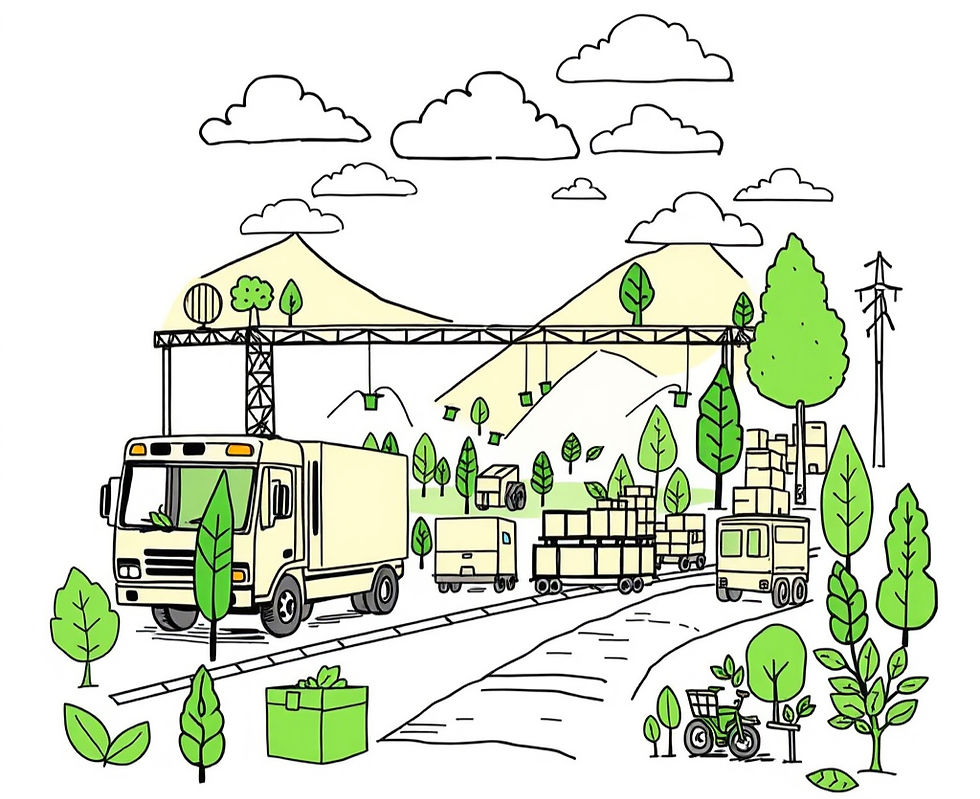
It is precisely because of these challenges that the SEE-GL project (Skills and Employment Enhancement in Green Logistics) has been established – an initiative financed within the Erasmus+ programme, which aims to bridge knowledge gaps and provide practical tools for the sustainable transformation of the logistics sector in Slovenia, Croatia, Bosnia and Herzegovina, Kosovo and Montenegro.
What is the SEE-GL project?
SEE-GL is a multinational initiative for vocational education and training (VET) that brings together six partner organisations from the Western Balkans region:
Project partners:
NOA (Independent Higher Education Institute) – Slovenia
POU AMC NG – Croatia (Project Coordinator)
CEPS - Centre for Business Studies – Bosnia and Herzegovina
Tempulli – Kosovo
Pannonia Consulting d.o.o. – Croatia
Z&S Global – Montenegro
The project focuses on strengthening competences and employment opportunities in the field of green logistics by developing customised educational programmes that respond to the specific needs of companies in the region.
Key objectives of the SEE-GL project
Identifying challenges and needs in the logistics sector
In its first phase, the SEE-GL project conducted extensive research into the socioeconomic situation and employment needs in the logistics sectors of all participating countries.
The research framework included:
A review of literature on ESG standards, regulations and best practices in each context
Identification of key stakeholders (governments, companies, professional associations, international bodies, educational institutions)
Surveys and focus groups to understand awareness of sustainability, barriers to implementation and training needs
Research findings:
Small logistics companies wish to improve their environmental impact, but often do not know where to start
High costs and complex regulations make green initiatives unattainable for smaller teams
Weak policy implementation, limited oversight and unclear incentive measures slow progress
There is substantial demand for practical tools and training that fit the daily reality of companies
Development of customised educational curriculum
Based on the research findings, the project is developing a customised curriculum for vocational training, which includes:
Environmental (Environmental) pillar of ESG:
Managing emissions and carbon footprint
Energy-efficient storage solutions
Optimisation of transport routes
Green warehousing and sustainable infrastructure
Micro-mobility in urban delivery (e-bikes, cargo bikes, automated parcel lockers)
Social (Social) pillar of ESG:
Workplace safety in logistics
Fair employment and professional development
Inclusive employment and educational accessibility
Responsible human resources management
Governance (Governance) pillar of ESG:
Business transparency and reporting
Ethical supply chain management
Regulatory compliance and certification
Strategic planning for sustainable growth
Enhancing employability and competences
The project does not merely develop theoretical knowledge – it focuses on practical skills that directly impact employment:
Digital tools for sustainability monitoring (real-time emissions tracking, analytics)
Implementation of green technologies (electric fleets, route optimisation, intelligent systems)
Climate risk management (adapting infrastructure to extreme weather events)
ESG reporting and transparency (how to build stakeholder and partner trust)
Why is SEE-GL important for the Western Balkans region?
Economic opportunity
Sustainable logistics is no longer merely a matter of compliance – it is becoming a competitive advantage. Companies that embrace ESG principles are:
More attractive to investors and international partners
Better prepared for future EU regulations (particularly in the event of potential membership applications)
Capable of reducing operational costs through energy efficiency
Responding to climate change
Transport and logistics make a significant contribution to greenhouse gas emissions. The SEE-GL project provides:
Practical strategies for reducing carbon footprint
Adaptation of infrastructure to climate change (flood-resistant roads, heat-resistant rail networks)
Early warning systems and digital solutions for adaptive routing
Social cohesion and inclusion
Smaller logistics companies are often excluded from global sustainability trends due to lack of resources. SEE-GL democratises access to:
Quality education and certification
Practical tools suited to smaller budgets
Networking and collaboration amongst companies in the region
Concrete project results
Research framework (already completed)
Comprehensive analysis of ESG practices in the transport and logistics sectors of all five countries, including a comparative review of ESG standards integrations.
Educational resources (in development)
Digital platforms for self-directed learning
Practical manuals for small and medium-sized enterprises
Modular courses in green logistics
Pilot training programmes (planned)
Pilot implementation of programmes in collaboration with local companies and logistics operators.
Certification (long-term)
Development of a standardised certification system for green logistics competences, recognised across the entire region.
Practical examples: How is ESG changing logistics?
Example 1: Green warehousing during the holiday season
During the Christmas holidays, when warehouses are at peak capacity, energy-efficient buildings, solar panels, automated storage systems and smart temperature regulation enable companies to manage large volumes whilst simultaneously reducing energy costs.
Result: Smoother operations, lower costs, improved ESG performance.
Example 2: Micro-mobility in urban delivery
E-bikes, cargo bikes and local micro-hubs reduce congestion, emissions and accelerate deliveries in dense urban areas, where traditional delivery vans struggle to operate.
Result: Faster deliveries, lower fuel consumption, cleaner cities, safer streets.
Example 3: ESG transparency as a competitive advantage
Companies that publicly disclose data on emissions, working conditions, fleet management and ethical governance:
Build investor trust
Strengthen relationships with suppliers
Increase their international visibility
Result: Long-term growth, improved credibility, greater resilience.
ESG policies are already part of national strategies across the entire region, but real change only occurs when these regulations reach everyday operations.
The SEE-GL project represents a bridge between theory and practice, ensuring that sustainability does not remain on paper but becomes the standard.
When policies are linked to actual operations, ESG becomes a measurable impact: safer workplaces, more efficient logistics systems, more competitive companies and a more resilient shared future.
Sustainability does not slow us down – it is the way we move forward.
The SEE-GL project is co-financed by the Erasmus+ programme of the European Union.
Update: 13 August 2025, 19 December 2025, 19 January 2026.


Comments